
Small workplace scenes that no one notices or questions. And yet, this is where everything shifts.
He had just arrived, elected, appointed, expected, carried by a clear discourse, almost naïve in its sincerity, convinced that with a clean mandate, fresh legitimacy, and the energy of beginnings, it would be possible to move what had seemed blocked for too long, and from the very first weeks he had convened, listened, mapped, and measured the extent of the terrain he had just inherited.
Very quickly, meetings followed one another, gatherings accumulated, and with every layer explored appeared a new line of confrontation, from powerful unions to satellite institutions, from professional orders to historical partners, from influential donors to economic actors who had supported the campaign and now expected a return, and the further he advanced, the more he understood that every real decision would open a distinct battle, costly, prolonged, uncertain.
He counted, first mentally, then almost methodically, the battles to be fought, those to be assumed publicly, those that would be played out in the shadows, those he would certainly lose, those he might perhaps win, at the cost of political capital he had not yet accumulated, and he began to feel that particular weight that resembles neither fear nor doubt, but the cold lucidity of someone who finally sees the system as it is, and not as it had been narrated.
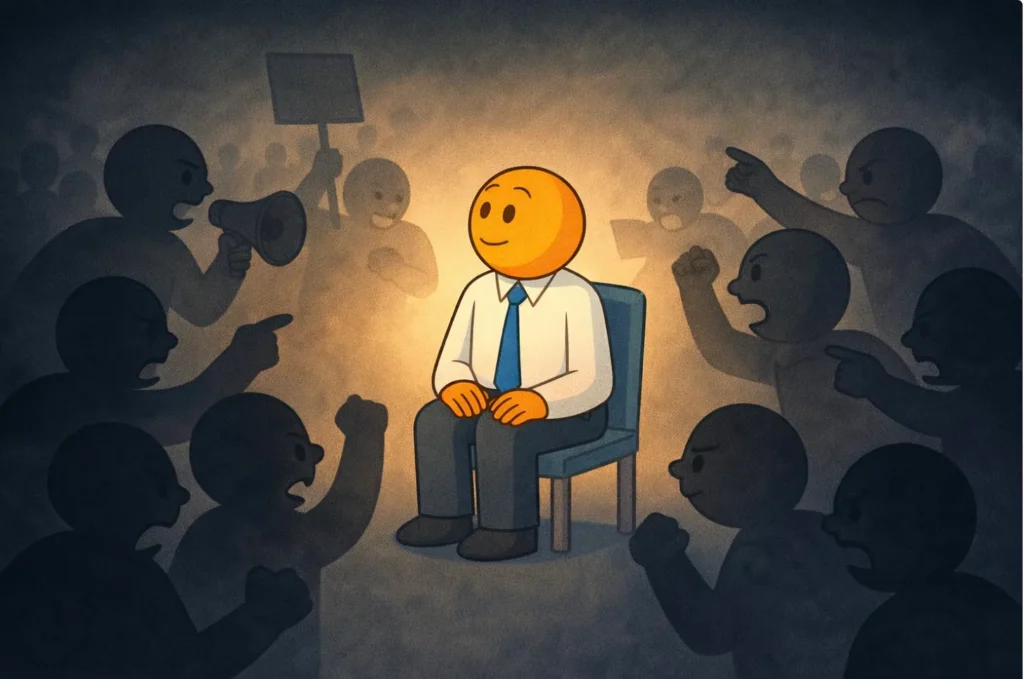
One evening, late, outside any official agenda, he found himself seated across from someone who held no institutional power over him, no mandate, no political agenda, someone to whom he could speak without strategy, without coded language, without implicit promises, and he said everything, the constraints, the pressures, the renunciations already envisaged, the compromises to come, and above all this question that returned incessantly, almost obsessively: what is the point of fighting if everything is designed to absorb, neutralize, dilute every genuine attempt at transformation.
The answer was neither heroic nor inspiring.
It was of an almost brutal simplicity.
He had four years. Four years to attempt a structural battle with little chance of success, at the price of permanent political violence, or four years to last, protect those close to him, preserve his image, and emerge intact from a system that never rewards those who truly force change.
And he understood.
He understood that the system never punishes those who renounce cleanly, those who transform abdication into a reasonable decision, those who know how to name complexity in order to justify inaction, and that courage, in such an environment, produces neither lasting recognition nor real victory, while restraint guarantees survival, respectability, and the appearance of continuity.
Nothing would collapse. No one would be directly responsible. Problems would be displaced, spread out over time, entrusted to future committees, to successors still unknown, and the system, intact in its structure, would continue to function exactly as it had been designed to do.
That day, he did not choose to lose.
He chose not to risk winning.
And in the months that followed, this choice would be praised as wisdom, maturity, political lucidity, while the consequences would be slowly transferred to those who had neither the voice, nor the mandate, nor the protection necessary to refuse to carry them.
The decision was not to govern.
It was to last.
Seedz / Silent Guest
Not a coach. Not a therapist.
A clear mirror — to see clearly, before choosing.