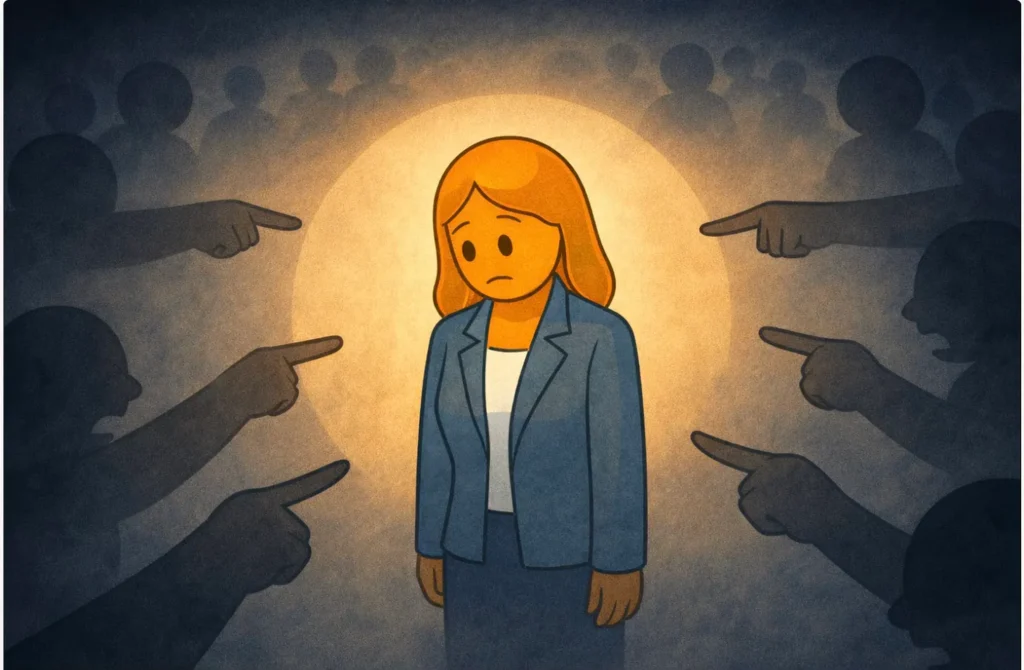
Four encounters with people who had stopped being contradicted — and wanted to turn the lights back on.
Introduction
Do you still think people tell you what they really think?
When you walk into the room, sentences change. They congratulate you, they validate you, they wait to know what you want to hear. It’s not fear — it’s survival.
And in the meantime, you lose touch with reality: the cost of groceries for a family of three; the traffic jams we’re told to love while a mother of three under five can’t imagine how to manage daycare → work → daycare on public transit; the collapse of trust when a repeat offender is released; the car insurance of a young worker on night shifts.
That’s how we end up with politicians whose only promise is to “manage better” than the previous one; judges defending their resources while the streets feel more unsafe; decision-makers cutting a bus line without realizing the hour lost by those catching two transfers at 6 a.m.
That’s where we come in.
Not to inspire, not to advise — but to say what no one says anymore, calmly, without an agenda.
We talk about reality, not the façade. No applause, no formulas — just what’s needed for you to see clearly, even when everyone agrees with you.

The Lawyer Who Wanted to Become a Judge
Her office smelled of leather and warm printer ink — that slightly sweet scent of paper just out of the machine. Winter light crossed the window and landed straight on the frames along the wall: awards, honors, peer recognition — a woman who had ticked every box without looking up.
I asked her why I was there. She said she wanted to become a judge, that she hadn’t done an interview in decades, that she wanted help.
So I asked her to tell me, simply, why she should be a judge.
She spoke for twenty minutes without taking a breath — flawless, precise, not a note out of place. The polished control of someone who has learned to arrange everything so nothing spills out.
When she finished, I leaned forward and said quietly:
— “If I close my eyes, I can’t see you.”
She blinked, once, twice.
— “Sorry? I don’t understand.”
— “You’re showing me what you do. Not who you are.”
A polite kind of anger rose. The list of accomplishments hit the table like playing cards.
— “Lawyer of the Year four years in a row. Built a department from scratch. On three boards that sought me out.”
— “Yes. Exactly.”
That “exactly” hung long enough for silence to do its work. Then her head dropped, just a little.
— “I’m exhausted. Everyone takes me for granted.”
That’s when the real work began — not inventing a persona (those always crack), but bringing the person back into the room. Giving her voice some color again, her shoulders some air, permission to smile when there’s never been space for one.
The day of the selection committee, the light on the table was too white, the water bottles aligned like witnesses. She walked in — not perfect, but present — with that human rhythm that doesn’t need to convince with every word, that pauses sometimes to think aloud.
You could see glances exchange, a note taken, a quiet smile from a jurist at a sentence that rang true.
She didn’t need to be appointed to know: this time, they had looked at her, not evaluated her. And that was already a win.
The Unmanageable Politician
Campaigns — local, municipal, presidential — all obey the same gravity. The serious ones call us eighteen months before, when the sweat doesn’t show yet and the ego still sleeps. Then there are the others — the ones who call when the engine knocks and the bodywork shakes.
This one was a popular elected official, two terms carved into habit, rolled-up sleeves, no tie, the Sunday market as a stage, first names flying around — the comfortable illusion that love from the crowd equals victory.
When his team called us, it wasn’t the TV shouting anymore, it was the networks: screenshots, messages piling up, long comment threads about his “too hot” posts. He was known for his temper, and a few months before the election, someone was making sure every tweet and misstep resurfaced.
He came in smiling, as if nothing was wrong.
— “Better to make noise than disappear, right?”
— “I don’t work with people who don’t want to be helped.”
I closed my notebook. I stood up.
His chief of staff ran after me in the hallway — overwhelmed, clearly out of control.
— “Please, find a way. We can’t handle him anymore. He doesn’t listen.”
— “No miracles. But maybe we can slow the fall.”
We widened the river around his turbulence. While he improvised on every platform and market corner, we flooded the networks with clear, factual threads — sharp analyses, timely op-eds, short messages that shut the doors before the fire spread. We drowned his outbursts under a flood of coherence: no attacks, just content, the same themes carried by credible voices, the same clean language that disarms without humiliating.
Every morning, the chief of staff slipped our lines into his briefings.
— “Read this — it’s exactly what you think.”
— “I don’t need talking points.”
— “Then improvise this.”
He thought he was improvising; he was quoting us without knowing it. The curve steadied.
The night of the debate, he stood firm — hands flat, answers tight, less about himself, more about the plan. He couldn’t resist a final “Now let’s grab a beer,” but this time, it passed as a joke. When the cameras went dark, he’d won.
— “Next time,” I told the team, “let’s start before the house is on fire.” Architecture is drawn cold, not in the sirens.

The Candidate and His Ugly
He was a respected man in his country — received where voices are low, carpets absorb sound, mint tea perfumes the room. He’d heard about us and wanted to meet.
He talked for three hours: roads to rebuild, schools to open, justice, growth, the future — every sentence gilded, a spotless theatre.
I leaned back in my chair, watched him, and said:
— “No. You’re not serious.”
He looked up, startled.
— “What do you mean?”
— “You’re giving me a beautiful story. I want the ugly.”
His adviser froze — where he comes from, you don’t talk like that. You say yes, you wait. He literally stopped breathing.
And me, small as a market stool, I had just moved the board one square forward.
The candidate let silence hang, then burst into a long, genuine laugh; his adviser exhaled mid-way.
— “You know… nobody ever asks me that. Not like this.”
— “That’s why I’m here.”
Then he spoke — not to justify, but to unload: mistakes that don’t fit slogans, anger misplaced, decisions carried alone for too long, and yes, affairs unspoken, those illegitimate ties that feed the tabloids but lose half their poison once said plainly.
We crafted a short, clean sentence — no excuses, no acrobatics. When the campaign launched, he accepted an interview on a regional podcast — not a friend, someone who’d push. He said:
— “Yes, it happened. I wasn’t honest in my private life. I own it. I’m not asking you to love me for it. Judge me on my work.”
The studio froze for a second, then breathed. It couldn’t become a scandal anymore. Just gossip — a touch of imperfection that made him human again. And from there, we could move forward.
The Patient Civil Servant
He talked about transformation the way others talk about oxygen.
He quoted Dodge in the U.S. — the courage to redraw plans instead of repainting walls. And in the same breath, he defended immigration as the engine of renewal — not as a slogan, but as a fact: a country that closes itself gets tired. He spoke up even when the room hated it. Not an ideologue — a practitioner of lucidity.
Fifteen years in the civil service, competence that doesn’t brag, teams that trust him. Yet promotions slid off him like rain off a duck. Always the same diagonal moves — forward, but never in front — while well-groomed silhouettes walked past, people who knew how to please.
— “I feel like they keep moving me sideways,” he said, not bitter, just tired.
I let him finish.
— “I’m too direct. It bothers them.”
— “You want to be a straight shooter or change things for real?”
— “I want to change things.”
— “Then learn the game. Not to get lost in it — to hack it. To bend the rule without breaking it.”
— “And if I refuse?”
— “Then you should’ve been an entrepreneur, not a civil servant.”
The silence that followed taught more than any leadership course.
The next day, we shifted his energy: fewer big speeches that froze rooms, more quiet social engineering — how to make ideas travel without signing them, how to let others carry them, how to pick the right ear, the right moment, the right tone. Not manipulation — survival, until the system starts to shift.
Six months later, he hadn’t changed jobs — but no decision was made without him. And, as of writing this, he’s just been offered a higher role.
Conclusion
Most of the people who call us have already given everything.
They’ve carried institutions, teams, causes — sometimes entire cities — until they’ve dissolved a little in the process.
They’re not cynics — just exhausted believers.
We don’t teach them to communicate better. We give them back the taste of what they do. It stings, yes. Transformation always does — especially for those who still have vision.
But once the fear of failure falls away, passion comes back. That’s why they come to us — to breathe again.
It’s not for everyone.
You need a steady heart — and a thick skin. But once the storm passes, you remember what you were fighting for.
Silent Guest — the friction of the real, with no costume and no applause.