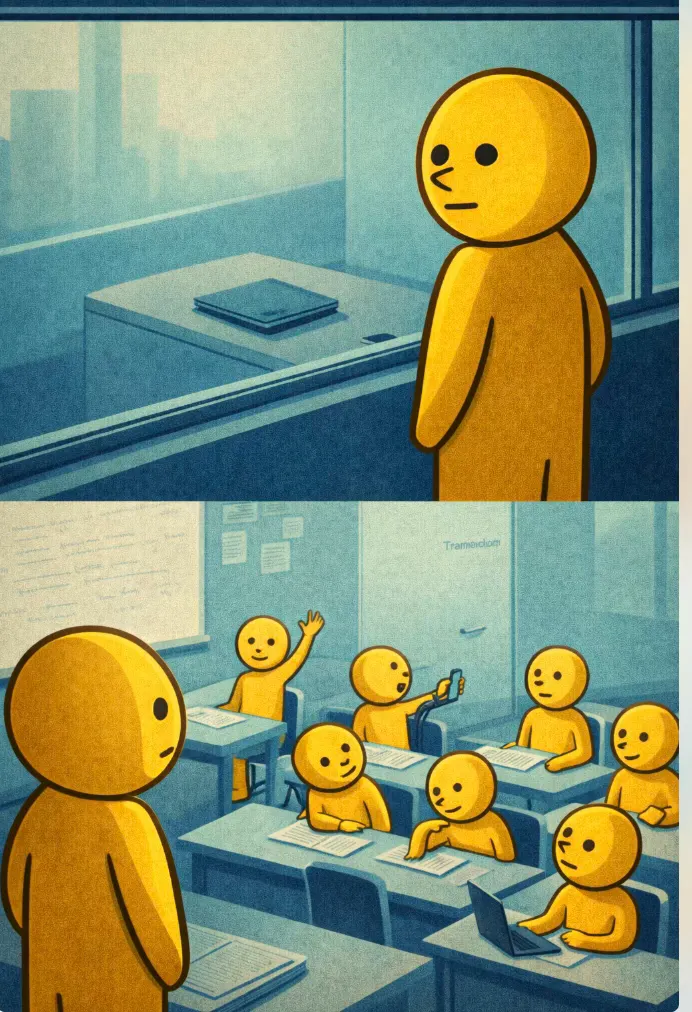
Small scenes at work that no one notices or questions. And yet, this is exactly where everything tips.
It is never brutality that makes a system dangerous, nor even blatant injustice, but that much more discreet, almost comfortable moment when no one really has the right to decide anything anymore, even when everyone around the table — or the counter — knows perfectly well what should be done.
The office is outdated, with walls too beige to feel clean, a color that sits somewhere in between, not quite white, not quite brown, not really dirty either, just enough to give the impression of “not quite.” Not quite clear. Not quite precise. And this not-quite already suggests that everything about to unfold here will carry the same tone.
On the other side of the counter, a citizen. Calm. Polite. A file in hand, prepared, checked, reread several times, the way you do when experience has taught you that the smallest approximation, the slightest “not quite,” can cost weeks.
The clerk looks at the screen, then at the file, then back to the screen, without irritation, without harshness, with that almost mechanical precision you acquire once you’ve learned not to improvise anymore.
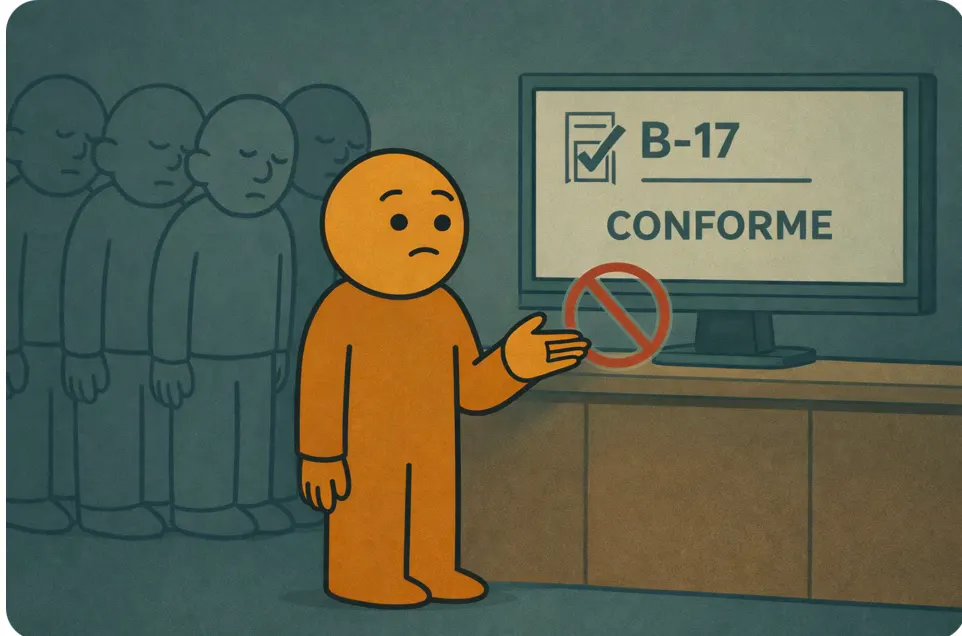
— “The B-17 form is missing.”
The citizen slightly frowns, not in anger, but with the quiet fatigue of someone who already feels the conversation slipping away.
— “The B-17? I sent it last month.”
The clerk clicks, scrolls, stops, then nods.
— “Yes. I see it. It’s in the system.”
A brief silence settles in, suspended, as if logic were about to naturally reclaim its place.
— “So… it’s fine?”
The clerk hesitates for a very short moment, not a moral doubt, more an internal check, then answers in the same even tone:
— “No. You need to provide it.”
— “But… you have it right there.”
— “Yes. But the procedure requires that you be the one to submit it.”
The citizen gives a nervous smile, the kind you have when you’re still trying to stay on the reasonable side of things.
— “Sorry, but this is a bit crazy, isn’t it?”
The clerk looks up. He doesn’t tense. He doesn’t defend himself. He doesn’t correct.
— “I agree with you.”
And this is perhaps where something truly cracks, because the absurdity is acknowledged, validated, shared — without opening the slightest possibility for action.
— “So… what do we do?”
The clerk resumes, still calm, almost pedagogical:
— “You need to resubmit the form through the portal. Then the system will automatically attach it to your file.”
— “Even though you already have it?”
— “Even though I already have it.”
The citizen takes a slow breath.
— “What if I send it to you right now?”
— “No. It has to go through the portal. Otherwise, it’s not valid.”
— “But that doesn’t change anything in substance, does it?”
The clerk gently closes the file, not like a refusal, more like a closing gesture.
— “In substance, no. In form, yes.”
They look at each other for a moment. Two perfectly rational people whose eyes meet. Two people who understand exactly what is happening. Two people trapped in a dialogue whose outcome has already been decided elsewhere.
— “If you were in my place, what would you do?” the citizen asks, without provocation, almost out of curiosity.
The clerk doesn’t answer immediately.
— “I would do exactly what you’re doing.”
Then, after a pause, more quietly:
— “But I can’t do anything.”
The citizen nods. He writes down the portal number. He thanks him, because that’s what you do when you understand that the conversation ended before it really began. He leaves.
The clerk remains there. On the screen, the file is still open, the form still visible, perfectly compliant, perfectly useless, prisoner of a system that knows exactly what it knows but refuses to draw any consequence from it.
The problem is not the form, nor even the procedure.
The problem is the organization that has methodically stripped its employees of the right to override a process that has become absurd — and then wonders why it fears the arrival of AI.
Because when no human is allowed anymore to decide, to assume, to cut beyond what is prescribed, AI does not represent a rupture, but a logical continuation, and the human slowly becomes the most cumbersome variable in the system.
Seedz / Silent Guest
Not a coach. Not a therapist.
A clear mirror — to see clearly, before choosing.