
Small scenes at work that no one notices or questions.And yet, this is exactly where everything shifts.
It is never the big decisions that damage an organization the most, but rather those reasonable adjustments, discussed at length, collectively validated, and from which everyone walks away convinced they were courageous.
The meeting doesn’t begin with an emergency, nor with a spectacular crisis, but with a number projected onto the screen, presented as self-evident: a $500,000 shortfall. Not a bankruptcy. Not a collapse. Just a gap to be closed, serious enough to demand effort, but not serious enough to challenge the structure itself.
Around the table, twelve people. Committed, intelligent executives, sincerely convinced they are working for a mission greater than their own interests, within a socially driven organization, dedicated to helping those with less, those who fall through the cracks, those for whom every abstract decision has very concrete consequences.
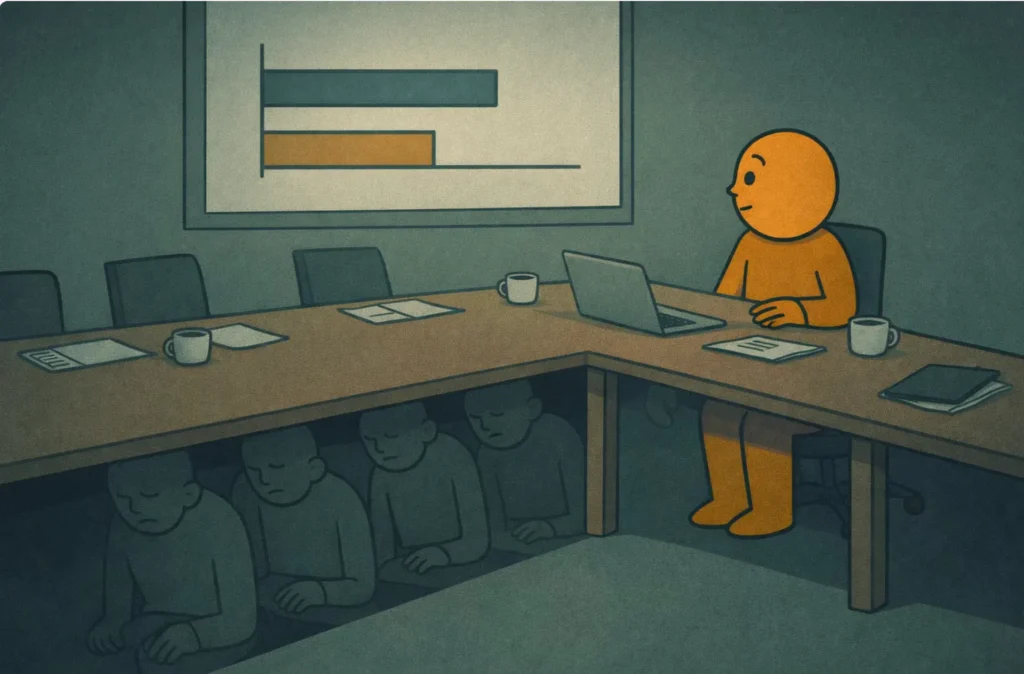
Very quickly, the discussion takes on a responsible tone. People talk about the economic context. Pressure from major donors. Signals to be sent to the board of directors. They need to show they are serious, that they can tighten their belts, that they are capable of making difficult choices.
The number then naturally splits into two parts, almost without anyone noticing.
$300,000 to adjust executive compensation. Nothing extravagant, just a “market adjustment,” a recognition of benchmarks, a way to retain talent, to ensure stability, because after all, you can’t steer a fragile organization with fragile leaders.
And $200,000 in cuts. The real ones. The ones that will be shown.
A meticulous, serious, almost painful process begins. Teams are reviewed. Harsh words are avoided. People talk about optimization. About fair distribution of effort. They look for where it will hurt “as little as possible.”
Very quickly, a solution imposes itself, logical, almost mathematical: reducing full-time positions at the bottom of the pay scale by one day per week. One day out of five. It’s not a layoff. It’s not a position elimination. It’s temporary. Responsible. Clean.
No one says out loud that these people already live with very little, that their budgets are tight to the millimeter, that losing one day of pay isn’t losing 20%, but losing the ability to breathe. No one says either that it’s almost impossible to find complementary work for just one day a week, and that this “small cut” will, in reality, push some even further into precarity.
But everyone knows.
Weeks are spent working on those $200,000. Figures are refined. Adjusted. Ensuring everything adds up, that the demonstration will be clear, that the message will be acceptable. There is some suffering, which helps convince everyone they have done the hard work.
Then comes the day of the board presentation.
Slides scroll by. The cuts are shown. Collective effort is emphasized. The decisions are explained as thoughtful, painful, necessary. The board nods. It sees numbers. It sees rigor. It sees responsibility.
Then, almost as a formality, the adjustment to executive salaries is quickly mentioned. $300,000. One line. One justification. The tone is neutral. The topic isn’t lingered on. No one really asks questions.
Around the table, something relaxes. Everyone feels strangely good.
The situation is resolved and the system has held. The numbers have passed, donors are reassured, governance has seen effort.
No one cheated or lied. Everyone played their role correctly.
The system simply did what it was designed to do.
And as long as it works,
there is no reason to look at it differently.
Seedz / Silent Guest
Not a coach. Not a therapist.
A clear mirror — to see clearly, before choosing.