
Small scenes at work that no one notices or questions.And yet, this is exactly where everything shifts.
It is not when employees ask for too much that a company falters, but when no one clearly remembers anymore what was an exception — and what should never have become a rule.
The employee is sitting across from HR. He is calm and he explains. He says he understands the economic situation, that he knows times are harder, but that he still finds it unfair to talk about cuts now, when over the past few years he had come to integrate that certain things were now part of the moral contract.
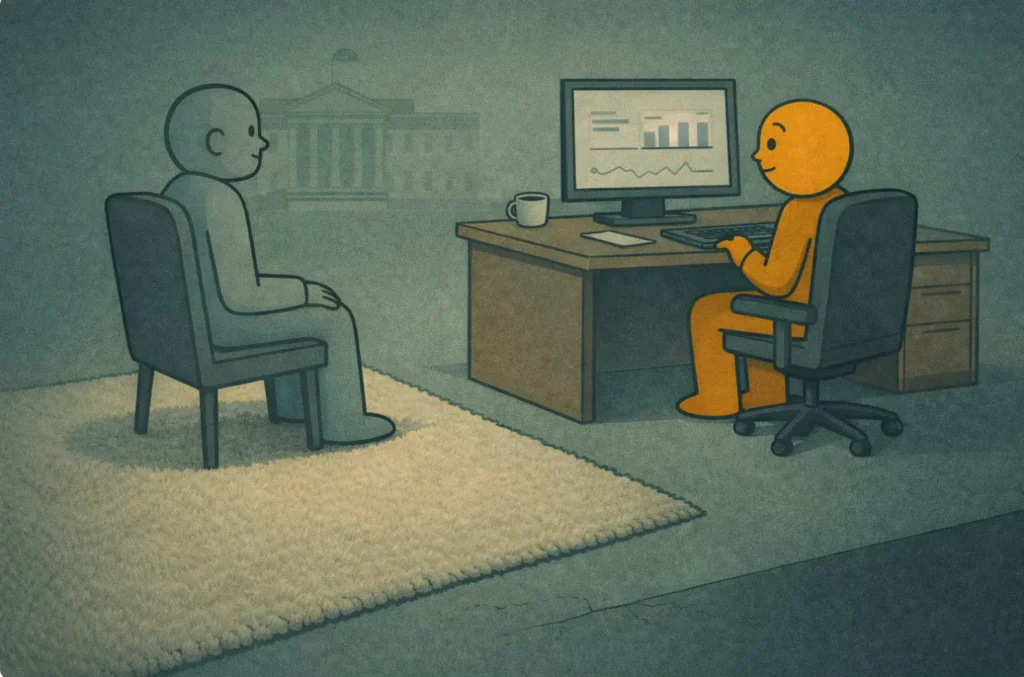
He talks about remote work, about the various benefits, about expense reimbursements.
He also talks about balance, salary progression, family leave.
He says all this calmly, almost with restraint, like someone who is not asking for a privilege, but for the continuity of a state that was once presented to him as normal.
HR listens. They take notes. They reframe. They do what they always do: they translate an emotion into a file, a perception into issues, a complaint into points to be addressed. Nothing abnormal. Nothing malicious.
Later, in another office, HR repeats the conversation to the CEO. Word for word. Without dramatizing. Without softening it either.
The CEO is not happy at all. Not with the employee, but with the situation. He talks about numbers and margins. He talks about cash flow. He reminds them that the company is not a public institution, that it does not have an infinite safety net, that current decisions are not ideological but accounting ones.
He says, irritated:
— “We can’t keep everything.”
A silence settles in.
HR does not contradict him. They do not defend the employee. They do not advocate.
They simply say:
— “You do remember that during Covid, we were the ones who explained that all of this was possible.”
The CEO frowns. Not out of denial — his memory comes back too quickly for that — the flashback is not emotional, it is factual.
During Covid, the state injected money on an unprecedented scale. Massive, rapid, sometimes disorganized aid that allowed companies whose models no longer really held up to continue paying salaries, maintaining benefits, preserving comfort, without value creation necessarily following.
At that time, no one cried communism, no one denounced interference.
Leaders took the money, relieved. They stabilized. They reassured. They even praised the system.
They also explained to teams that the company was holding, that the system was working, that the worst was behind them.
And without really intending to, without ever formalizing it, they helped install a dangerous idea: that the company could survive independently of its economic reality, and that acquired comfort was no longer a variable, but a right.
HR reminds the CEO of this, without accusation:
— “At the time, we all validated that discourse. We even carried it.”
The CEO looks at the figures on his screen. They are clear. They say that public money is gone. That aid has been withdrawn. That the company must now once again live from what it produces, sells, invoices — and not from what it is given to keep going.
But the discussion is no longer in the same place.
Decisions are now justified as if the company’s disappearance were unthinkable.
It is not the employees who have changed. They are reacting exactly to what they were taught during the crisis.
For a time, the company functioned without depending on what it actually produced.
That time is over.
But expectations remained. Because an exceptional situation was presented
as a new normal state.
And economic reality never validated that shift.
Seedz / Silent Guest
Not a coach. Not a therapist.
A clear mirror — to see clearly, before choosing.